



Table of Contents
Scaling the Heights: Building the Ultimate 7.1.4 Dolby Atmos Studio with Neumann
The shift from stereo to immersive audio isn’t just an upgrade; it’s a total reimagining of the sonic canvas. For many of us, the Neumann KH 310 A has long been the “gold standard” for stereo precision—a monitor that tells the absolute truth. But how do you take that legendary analog honesty and scale it into a modern, 15-unit Dolby Atmos array?
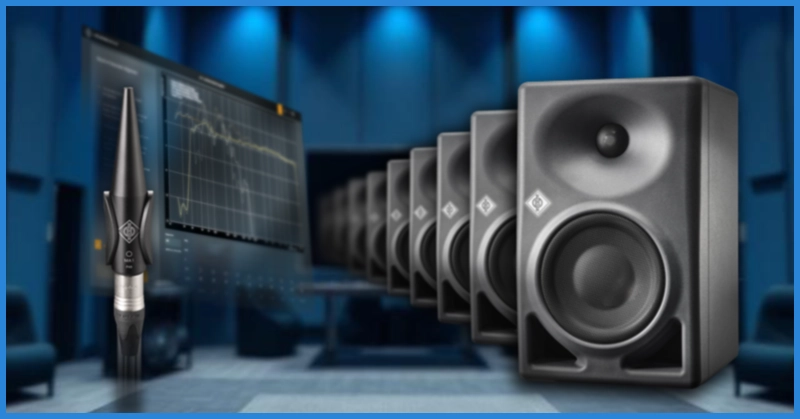
In this post, we’re breaking down the architecture of a dream “No-Compromise” immersive system. We aren’t just adding height channels; we are creating a phase-linearized, high-headroom powerhouse. By anchoring the front stage with three KH 310s and a massive “Quad-Sub” foundation of four KH 750 DSPs, we’ve designed a system that brings digital surgical precision to an analog heart.
From calculating the RMS power needed to drive such a beast, to managing the thermal output and the network backbone required for MA 1 alignment, here is the complete blueprint for a 7.1.4 environment that defines the future of mixing.
Comprehensive System Budget
This budget includes the full set of monitors and subwoofers required for the 7.1.4 configuration, including the two Neumann KH 310 A units and four Neumann KH 750 DSP units discussed.
| Component [1, 3, 4, 5, 6] | Quantity | Price (per unit) | Subtotal |
| Front L/C/R: Neumann KH 310 A | 3 | ~22,690 SEK | 68,070 SEK |
| Subwoofers: Neumann KH 750 DSP | 4 | ~17,190 SEK | 68,760 SEK |
| Side & Rear Surrounds: Neumann KH 120 II | 4 | ~8,290 SEK | 33,160 SEK |
| Height Channels: Neumann KH 80 DSP | 4 | ~5,690 SEK | 22,760 SEK |
| Alignment Hardware: Neumann MA 1 Measurement Mic | 1 | ~2,800 SEK | 2,800 SEK |
| Software License: MA 1 Multichannel Extension | 1 | ~3,400 SEK | 3,400 SEK |
| TOTAL ESTIMATED BUDGET | ~198,950 SEK |
System Description: 7.1.4 Immersive Environment
I. Core Monitoring Architecture
This system utilizes a three-way front soundstage composed of three Neumann KH 310 A monitors. These units are prized for their ultra-fast transient response and dedicated midrange dome, which ensures precise vocal placement and imaging in complex Atmos mixes.
II. The “Quad-Sub” Bass Foundation
The system’s low-end is handled by four Neumann KH 750 DSP subwoofers.
- Dual-Channel Integration: By assigning two subwoofers to the Left channel and two to the Right, the system achieves massive headroom that matches the high SPL capability of the KH 310 A monitors.
- Room Mode Mitigation: Four subwoofers allow for superior distribution of low frequencies, effectively canceling out standing waves (room modes) for a consistent bass response across the entire listening area.
- Sealed Cabinet Synergy: The sealed design of both the KH 310 A and KH 750 DSP ensures a phase-coherent, “dry” bass sound ideal for surgical studio work.
III. Surround & Height Array
- Bed Layer: Four Neumann KH 120 II units provide the side and rear surround information. Their modern DSP engines allow them to be perfectly timbre-matched to the KH 310 A fronts.
- Height Layer: Four Neumann KH 80 DSP units are utilized for the overhead Atmos positions. These are compact enough for versatile ceiling mounting while maintaining the necessary SPL for immersive peaks.
IV. Unified DSP Calibration
The entire 15-unit array (11 monitors + 4 subs) is calibrated using the Neumann MA 1 Automatic Monitor Alignment system with the Multichannel Extension. This software applies FIR phase correction across all speakers, ensuring the analog KH 310 A units behave with the same digital precision as the DSP-based monitors.
Neumann typically defines these as “Rated Power” or “Continuous Output” measured at 0.1% THD+N (with limiters deactivated) to provide a realistic view of their sustained performance.
1. Neumann KH 310 A (Front LCR)
The KH 310 A uses a sophisticated Class AB tri-amplified design. Unlike Class D, these Class AB amplifiers are chosen for their linear performance across the critical midrange.
- Woofer (8.25″): 150 W (RMS)
- Midrange (3″): 70 W (RMS)
- Tweeter (1″): 70 W (RMS)
- Total Continuous Power: 290 W per speaker.
2. Neumann KH 750 DSP (Subwoofers)
The KH 750 DSP uses a high-efficiency Class D amplifier. Because it is a sealed cabinet pushing a 10″ long-throw woofer, this amplifier is designed for high current delivery.
- Woofer (10″): 256 W (RMS)
- Design: Integrated switched-mode power supply (SMPS) with an active protection system
3. Neumann KH 120 II (Side & Rear Surrounds)
The second-generation KH 120 II moved to a high-power Class D bi-amplified architecture, which significantly increased the continuous power compared to the original model.
- Woofer (5.25″): 100 W (RMS)
- Tweeter (1″): 80 W (RMS)
- Total Continuous Power: 180 W per speaker.
4. Neumann KH 80 DSP (Height Channels)
The KH 80 DSP features a compact Class D bi-amplified system. It is designed to maintain high output levels in a small form factor without the need for heavy heat sinks.
- Woofer (4″): 90 W (RMS)
- Tweeter (1″): 50 W (RMS)
- Total Continuous Power: 140 W per speaker.
Revised Summary Table (RMS Power)
| Model | Amp Type | Configuration | Total RMS Power |
| KH 310 A | Class AB | Tri-amplified | 290 W |
| KH 750 DSP | Class D | Single Amp | 256 W |
| KH 120 II | Class D | Bi-amplified | 180 W |
| KH 80 DSP | Class D | Bi-amplified | 140 W |
Total System Power: With 11 monitors and 4 subwoofers, your entire 7.1.4 system has a combined continuous output of approximately 2,154 Watts RMS.
To help you plan the cooling for your studio, here is the calculated heat dissipation for your complete 7.1.4 system. These figures represent the maximum thermal output at full load, which is essential for ensuring your HVAC system can maintain a stable temperature during intense mixing sessions.
Thermal Dissipation Breakdown (Full Load)
The KH 310 A generates the most heat due to its Class AB architecture, while the KH 750 DSP and other monitors use more efficient Class D amplifiers that run cooler.
| Model [1, 2] | Quantity | BTU/hr (Per Unit) | Total BTU/hr |
| KH 310 A | 3 | ~820 | 2,460 |
| KH 750 DSP | 4 | ~280 | 1,120 |
| KH 120 II | 4 | ~190 | 760 |
| KH 80 DSP | 4 | ~130 | 520 |
| TOTAL SYSTEM OUTPUT | 4,860 BTU/hr |
Summary for HVAC Planning
- Total Heat Load: Your 7.1.4 system generates approximately 4,860 BTU/hr (or ~1.42 kW) of heat at maximum output.
- Cooling Recommendation: For a standard studio room, you should have an air conditioning capacity that exceeds this total. A common 12,000 BTU (1-ton) unit is typically more than enough to handle this equipment plus lights, computers, and personnel.
- Idle Heat: When not in use, the system generates roughly 750 BTU/hr, though the KH 750 DSP and other DSP monitors feature an auto-standby mode that reduces this to negligible levels after 90 minutes.
Electrical Load Note
Your system has a combined maximum power consumption of roughly 2,154 Watts RMS. To avoid tripping breakers during high-transient peaks, it is highly recommended to run this system on at least two dedicated 10A circuits (in 230V regions) or two 20A circuits (in 120V regions) to separate the subwoofers from the main monitors.
To align a 7.1.4 system with 11 monitors and 4 subwoofers, you need a network infrastructure that allows the Neumann MA 1 software to communicate with every DSP-enabled device simultaneously.
Network Switch Requirements
For this specific setup, your switch must meet these three criteria:
- Port Count: You need a minimum of 16 ports (11 for monitors, 4 for subwoofers, and 1 for your computer).
- Protocol Support: The switch must support IPv6. This is a non-negotiable requirement for the Neumann DSP discovery protocol.
- Standard Ethernet: High-speed Gigabit (10/100/1000 Mbps) is recommended, though the data being sent (calibration filters) is not bandwidth-intensive.
Recommended Switches for Your System
While any standard unmanaged Gigabit switch with IPv6 support will work, the following are reliable options commonly used in professional studios for Neumann alignment:
- NETGEAR GS316 (16-Port): A widely available, “plug-and-play” unmanaged switch that is silent (fanless) and fully supports the required discovery protocols.
- TP-Link TL-SG1016 (16-Port): Another silent, rack-mountable option that is highly cost-effective and reliable for permanent studio installations.
- Ubiquiti UniFi Switch (16 or 24-Port): If you prefer a managed system where you can see all your speakers on a dashboard, these are excellent but require slightly more technical setup.
Pro-Tip: Network Mode vs. Local Mode
When you connect your system, ensure the “Control Mode” switch on the back of every KH 750 DSP, KH 120 II, and KH 80 DSP is set to “Network”. This allows the MA 1 software to bypass the physical knobs on the back and take full digital control.
Important: Temporary vs. Permanent Connection
Once the MA 1 Alignment is complete, the correction data is stored locally inside each speaker’s memory. You can technically disconnect the network cables after calibration, but most professional studios keep them connected to allow for quick “A/B” testing or future recalibrations if the room layout changes.
These user experiences and troubleshooting guides explain how to set up your network switch and speakers for Neumann MA 1 calibration:
Neumann DSP Monitors with MA1 correction – My experience – Reddit
MA 1 – Output Signal Level Adaptation Troubleshooting – Neumann
Neumann Monitor Alignment kit 2: 2 x KH 80 DSP en MA1 – Lobbes Pro Audio
Room Correction Made Easy | The Neumann MA 1 System – YouTube
MA 1 – Automatic Monitor Alignment – Neumann – Neumann
Welcome to the MA 1 | Part 5 – Setup Scenarios – YouTube
🛠️ The “Final 5%”: Don’t Forget These Essentials
Building a 15-speaker array is a massive undertaking. Beyond the monitors and subs, these are the critical “hidden” components you need to budget for to get the system off the ground.
- Clean Power: With over 2,000 Watts RMS of potential draw, a Power Sequencer (like a Furman) is highly recommended. This ensures your 15 speakers turn on and off in the correct order, preventing the “thump” that can damage drivers or trip breakers.
- The Network Backbone: You need 15x Cat6 Ethernet cables (one for every DSP unit) and a 16-port Gigabit Switch (e.g., Netgear GS316). Even if you plan to run the system analog, these are required for the MA 1 Automatic Alignment process.
- Analog Connectivity: A 7.1.4 system requires a lot of copper. Budget for high-quality balanced XLR cables:
- 3x Long runs for LCR (Fronts)
- 8x Medium/Long runs for Surrounds and Heights
- 4x Short “jumper” cables if you plan to daisy-chain the KH 310s through the KH 750 subwoofers.
- Mounting & Physics:
- Heights: 4x specialized ceiling mounts (e.g. Neumann LH 45 or K&M 24471) for the KH 80 DSPs.
- Decoupling: Professional isolation stands or pads (like IsoAcoustics) for the three KH 310s to prevent energy transfer into your desk or floor.
- The “Brain” License: Remember that the standard MA 1 software only handles stereo. You must purchase the MA 1 Multichannel Extension license separately to align more than two speakers.
Final Professional Tip:
Before you bolt those KH 80s to the ceiling, run your Ethernet and XLR cables first! In an Atmos room, cable management is 50% of the labor
Conclusion: The Future of Your Sonic Canvas
Building a 7.1.4 system of this caliber is more than just a financial investment; it’s a commitment to a new way of hearing. By pairing the legendary analog soul of the KH 310 A with the modern digital intelligence of the KH 750 DSP and MA 1 alignment, you aren’t just filling a room with sound—you’re creating a surgical instrument for the immersive era. Whether you’re tracking a delicate vocal or mastering a high-impact cinematic score, this “Quad-Sub” foundation ensures every transient is felt and every placement is pinpoint accurate.
The transition to Atmos can feel like a steep climb, but once you hear the phase-linearized clarity of a fully aligned Neumann array, there’s no going back to “just stereo.”

** Feel free to share your comments, questions, or technical issues, as well as your suggestions for new articles on specific topics, by emailing us at info@mdsoundproductions.com. We speak English, Swedish, and Romanian.